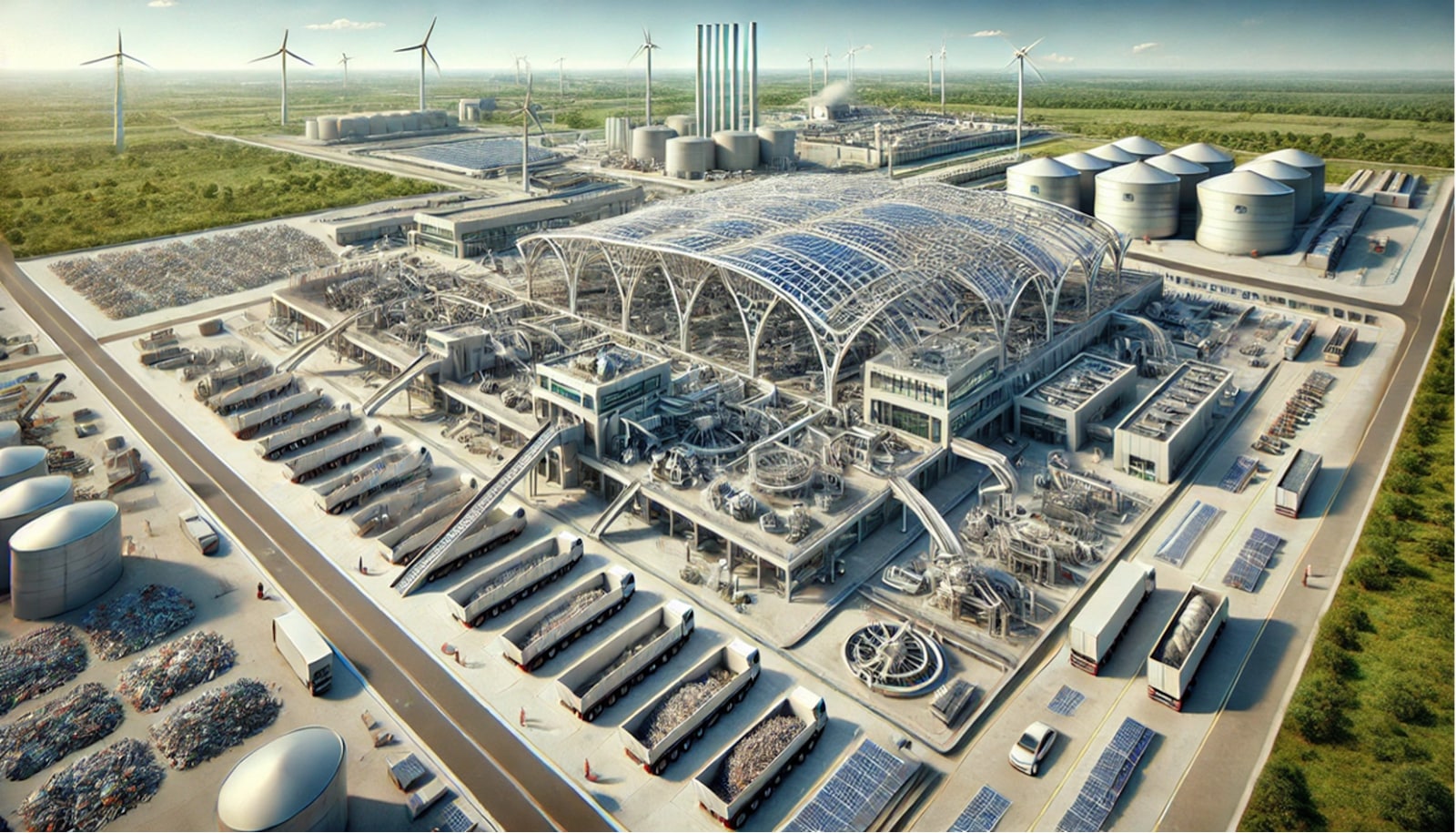
Envision a Clean Clear Future

Embark on a journey with TWC Recycle, a journey that seeks the sourcing of resource through low carbon emission processes, limits landfill toxicity, and secures a consistency of resource supply by harvesting minerals and metals from what has been thrown away.

Vision and Mission

“A world where we always have flowers to smell.”

To lead global sustainability in recycling Technology Complex Waste®, (TCW®).

Our Philosophy

Waste is a critical national resource. Recycling should be defined as the reclamation of materials for the benefit and security of the nation. Recycling is not the removal or prevention of landfill dumping and the subsequent export of a crushed mass whose real value benefits parties outside of South Africa.

Waste Management is no longer a gathering of product that then gets redistributed as scrap, squashed to minimise landfill space, or crushed so that high value metals may be recovered outside of environmental compliance and consideration.

Waste management has become the new chemistry, enabling the extraction of all metals and minerals from products with complex technologies within environments that enable product surgery and recovery to be productive, efficient and without harm.

Technology Complex Waste® broadly encompasses all products and components that secure functionality within high technology sectors and their subsectors, including but not limited to artificial intelligence, defence structures, (land, air and sea), robotics and drones, IT, wire and wireless communication structures, aerospace and satellites, energy, (nuclear, coal, renewables and battery energy storage systems), the transport sector including the motor industry, (EV and carbon fuelled), aviation and marine industries, the medical sector across all diagnostic products, the space industry and all electric or battery energised products manufactured for domestic or industrial usage within all economic sectors.

“Technology Complex Waste®” or (TCW®), is the term given to end of life product that may individually contain small, even minute, volumes of both rare and primary metal and minerals that cannot be recycled economically from a quantitative perspective but collectively will contain sufficient metal and mineral resource capacity for recovery and reuse. The use of new breakthroughs in chemical, physics and artificial intelligence process technologies is unlocking the mining potential of TCW® waste.

Our Four R’s

Re-USE and Repurpose Sub-Industries

“First recover, then re-use, then repurpose and use, and then exploit retired products and components.”

The critical component of waste management is to maximise usage of already manufactured product, whilst impacting positively on essential socio-economic sectors such as education, health, and development.

TWC Technologies has three key principles that are applied prior to the recycle exploitation:

Batteries can revolutionise non-urban development and safeguard the education of the next generation by enabling access to energy through appropriately costed renewable energy storage systems.

Leaning on the “access to technology” and the “access to communications” sectors, the ability to charge and use computers and cell phones, may well not just benefit outlying education but revolutionise it.

The intent to establish second life production within South Africa, production that sees the legally required retention of EV batteries so their healthy cells may be harvested for second life stationary battery energy storage.

This is a key objective of TWC Technologies.

Computers and I-pads and tablets provide information and communication channels that enable communities to realise commercial, health, education, and social benefits.

The intent to establish access to computers that will provide entry level access to the modern world at the most affordable entry level and then with upgrades that enable development to be unhindered, enables and empowers communities awash with a young population searching for the same opportunities as their urban based age groups.

This is a key objective of TWC Technologies.

Mobile phones and in particular smart phones contain more computerised technology than the engineering requirement that sent man into space. Communication capacity should include all communities, so that they too may realise the commercial, health, education, and social benefits of communication technology.

This is a key objective of TWC Technologies

For TWC the application of the three principles does not qualify as successful compliance to environmental standards. The delay of “end of Life” is only that, a delay. Environmental compliance only happens at end of life, and TWC subscribes to the belief that this is a national resource opportunity given the expanding role of metals and minerals contained within technology complex waste for future industries including defence, artificial intelligence and energy.

Technology Complex WasteR is obtained from 25 product sectors, e-waste is one of the 25 sectors, the sum of parts generating over 100 million tons of waste per year. Waste is the greatest known unexploited resource globally. The national obligation is to secure it.

TWC applies the four principles that must be present for successful recycling exploitation.

The first is to minimise the overburden and to minimise the process of waste. This begins with the physical separation of components and their sorting by the dominant element. This will be achieved by using AI robotics. The purpose is the maximisation of specific metal/mineral grade concentration prior to any metallurgical process.

The second principle is ensuring the accumulation and storage capacity is of sufficient compliant capacity for components, as defined by their dominant metal/mineral, until such time as the required commercially viable process quantum is attained.

The third is maximising throughput product to ensure a commercially viable extraction that achieves the purity structures required by the market. The resultant waste material of the process is then recycled under the same concentration principle.

The fourth principle is to ensure logistic cost is minimised. Logistics add no value to the product but are a principal cost. Plant location and the logistic structures that both feed the plant and then distribute the final product is therefore a critical consideration.

The unique ability to create within a single site, bulk exploitation of possibly 50 of the known elements creates new

TWC Technologies is driven by a diverse, passionate, and highly skilled team of professionals who share a commitment to innovation, sustainability, and excellence. Our leadership and staff include:

  • Technology Complex Waste Experts: Engineers and scientists with deep expertise in metal and mineral chemistry, metallurgy diagnostics and extraction, toxic waste management, and the adherence to the highest standards of performance and safety.
  • Sustainability Advocates: Environmental specialists dedicated to advancing the circular economy, landfill recovery, the reuse and repurpose of working products and components, reducing carbon emissions, and minimizing the ecological footprint of battery production.
  • Innovative Engineers: Creative professionals who seek continuous improvement in every aspect of the processes applied to the sustainable recovery of metals and minerals.
  • Industry Pioneers: Visionary leaders with decades of experience in investigating and embracing innovative technology, sustainable manufacturing, and driving the company’s mission to redefine waste management.
  • Diverse and Inclusive Talent: A team that reflects a commitment to equity, inclusion, and diversity, fostering a collaborative environment where innovation thrives.

Our project leadership are people united by a shared passion for solving complex challenges and making a tangible impact on the planet. They bring a blend of technical expertise, environmental consciousness, and entrepreneurial spirit to every project, ensuring that being a global leader in sustainable energy solutions becomes a reality.

We have an enormous talent and skills pool in South Africa.

TWC Recycle will seek to identify, nurture and employ standout students in the fields of chemistry, physics, biology, chemical engineering, metallurgy, robotic engineering, coding, IT and artificial intelligence.

South Africa is the home of many intellectual firsts and TWC intends to follow this trend by being a first mover in understanding the creation and exploitation of the urban mine.

TWC believes the identification and securement of resource supply requirements is essential for the future and the development of the skills that secure this sustainability is a cornerstone strategy.

What our Future Campus and Process Facility looks Like