Technology Complex Waste®, (TCW®), Explained

Technology complex waste broadly encompasses all products and components that secure functionality within high technology sectors and their subsectors, including but not limited to artificial intelligence, defence structures, (land, air and sea), robotics and drones, IT, wire and wireless communication structures, aerospace and satellites, energy, (nuclear, coal, renewables and battery energy storage systems), the transport sector including the motor industry, (EV and carbon fuelled), aviation and marine industries, the medical sector across all diagnostic products, the space industry and all electric or battery energised products manufactured for domestic or industrial usage within all economic sectors.

“Technology Complex WasteR” or (TCWR), is the term given to end of life of all products that may individually contain small, even minute, volumes of both rare and primary metal and minerals that individually cannot be recycled economically but collectively contain sufficient metal and mineral resource capacity for recovery and reuse. Our use of new breakthroughs in chemical, physics and artificial intelligence process technologies is unlocking the mining potential of TCWR waste.

Advanced Chemistry, Hydrometallurgy and Metallography Technology

TWC Technologies subscribes to a belief that the stage of global economics is entering a new phase, an era of clean renewable energies, the pursuit of reduced carbon emissions in all industrial processes and an urgent and critical need to securitize dwindling resources through the harvesting of metals and minerals from retired products.

TWC Technologies believes that recycling includes maximising the use of current product, an ethos where product may be retired by one sector but usable in another, be pursued before recycling is initiated. The ethos extends to component reuse.

Africa is behind the energy, communication and IT curve. TWC Technologies believes that access to affordable entry to these three key economic growth factors must be a critical element in the strategy.

The paradigm of technically complex waste management has moved. TWC Technologies believes in the inclusion of artificial intelligence, advanced chemical technology and the separation of materials through advanced hydrometallurgy, whilst working in synergy, when appropriate, with the traditional crush and heat process of pyrometallurgy. Waste recovery is science, not the pillage and plunder of valuable resources for quick gain.

The art of minimising negative environmental impact, the separation, collection, (including toxic elements), and the ability to create commercial quantum concentrates, enables and validates the extraction of all metals and minerals within the waste value spectrum.

Metals and minerals with a product concentration measured in a part per million quanta can, through the application of the theory of selective concentration, be harvested.

The science of concentration, the separation into multiple parts, with each part dominated by a single metal, collated from a multitude of products, enables a commercially

Understanding Complicated Product

The Product Example – Cell Phones

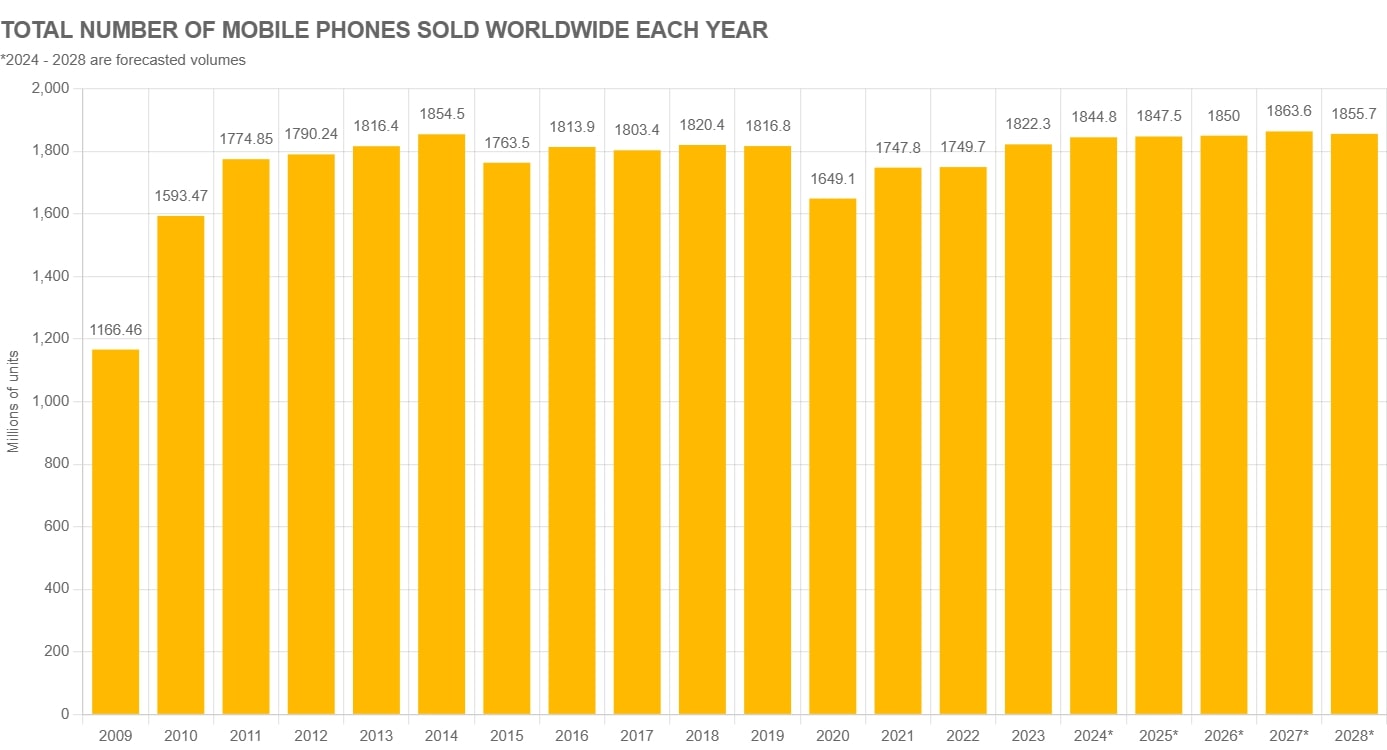
Sale of cell phone statistics tabulate global cell phone sales at 4.99 million sales per day with the following table illustrating sales and projections from 2009 to 2028.

Table1: Global Mobile Phone Sales

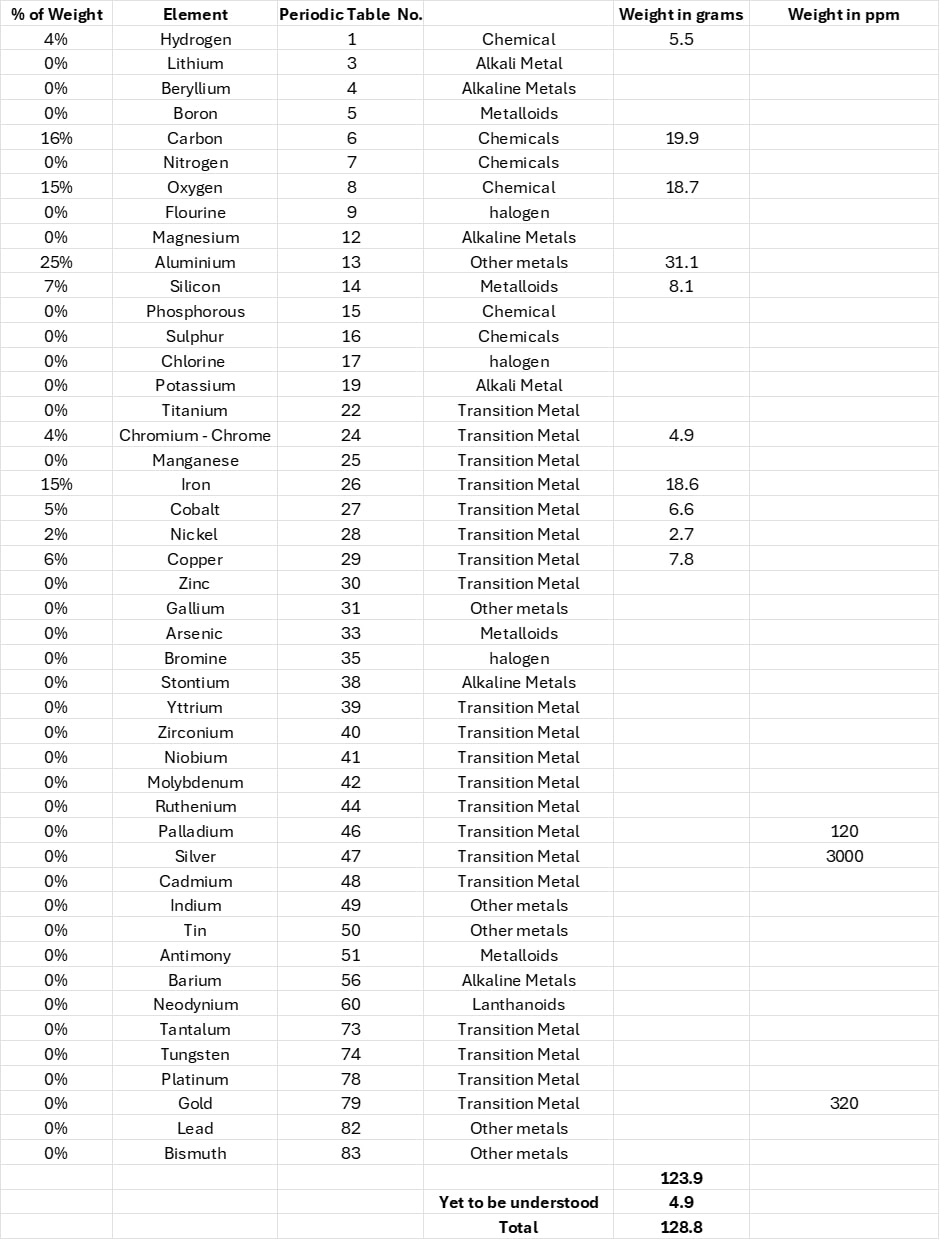
For example, a smart phone weighing 129 grams contains 46 elements. Gold is present at a weight of 320 parts per million, or 0.032 grams. Gold represents 0.025% of the weight of a phone.

However, using the estimated 35 billion phones manufactured and sold since 2006 as a base the collective potential is a global gold mine resource approaching 1500 tons, valued at 1,127 trillion dollars.

Chasing the gold at the exclusion of all other critical metals denies the real value available.

The ability, using robotic AI identification capabilities enables the physical separation of components by its dominant metal/mineral from the phone circuit board, thereby limiting the complication of a generic black mass, in either a solvent or powder structure. This simplifies chemical separation to components of similar metal/mineral/chemical structure, renders storage a strategic volumetric, and increases the yield potential for all dominant elements, whilst creating simplified solvents containing the minority elements for secondary extraction.

Breaking the Elements Down

Metallography plays a crucial role in many fields, including aerospace engineering, automotive engineering, and industrial manufacturing. And now waste. Metallographic analysis is essential for understanding the mechanical properties of materials including their grain size and crystal structure.

The identification process is essential. The use of AI robotics for phase 1, physical separation, enables extraction concentration benefits for each of the elements.

The accumulative effect, the grade per ton concentrate is often higher than the mining of new resource.

Continuing the use of the cell phone as the working example:

It is estimated that 14 magnets are used in each cell phone. The magnets are microscopic and extracting the neodymium re earth mineral is only possible through new chemical technologies.

Knowing the presence by weight aids the ability to determine the cost efficiency of extraction.

With a current smart phone population of 27 million active phones, South Africa has a “urban” resource value of gold of around US$ 698 million or ZAR 12.6 billion. With an expectation that South Africa remains a growing market, one that should double over the next ten years, the waste resource opportunity is a ZAR25 billion growing possibility. With a 5-year end of life expectancy, 5.4 million phones, with 12.5%, 0.675mliion, being used for repair, repurpose and reuse, a resource of 4.725 million phones is estimated to be available annually. At a collection variable of 50% and a 75% extraction efficiency, the exploitable gold resource value on an annual basis equals ZAR 825 million. When combined with the other elements the exploitable resource value of “end of life cell phones in South Africa exceeds ZAR 1.2 billion annually.

Figure 2: Elements Require din a Single Smart Phone – iPhone Example

Quantum Outcomes

The extraction of lithium contained within the power unit of a cell phone is less than one gram.

However, a process estimate of 5 million phones equals 5 tons of lithium carbonate per year. This contribution is a small but important part of the collective quantum for all domestic, medical and industrial use of small lithium batteries.

The isolation of the small battery unit and its alignment to all lithium batteries in respect of metal/mineral content creates additional concentration of extractable stock and the cell phones batteries are therefore, not processed, as a single line but alongside the lithium component of portable, ESS batteries and EV batteries. Domestic batteries form the current bulk of lithium stock in South Africa. The combination of the sum of parts creates the commercial quantum.

The copper component of EES and EV batteries is estimated to supply 2500 tons of copper. The copper component of the remaining sectors of TCWR equals 3360 tons of copper. It is the combination of the 2) sectors that enables recycle recovery to be commercially viable at 5800 tons. This means that every product that contains copper has a role to play.

The behavioural change requires a paradigm shift, no TCWR waste can be exported out of SADCC, it is too valuable. The establishment of the in initial plant will require as much TCWR waste material from within SADCC to be accepted to ensure the quantum required is achieved. Once established the need for territorial expansion of facilities and the advantages of a location must be explored.

Summary

Leadership and The Wonderful Possibilities of Developing New Science

TWC Technologies believes the scope and sheer volume of the mountain of benefits to be derived by proactive policies in respect of waste cannot be over exaggerated, and that recycling will become an “economic health” reporting sector.

TWC Technologies believes that South Africa has the means, the skills and the ability to be a global leader in the new science and management of resource security through waste management.

A Mountain of Benefits